Salt-Free Water Softeners Explained
Compare salt-free conditioners to traditional softeners and get no-obligation quotes.
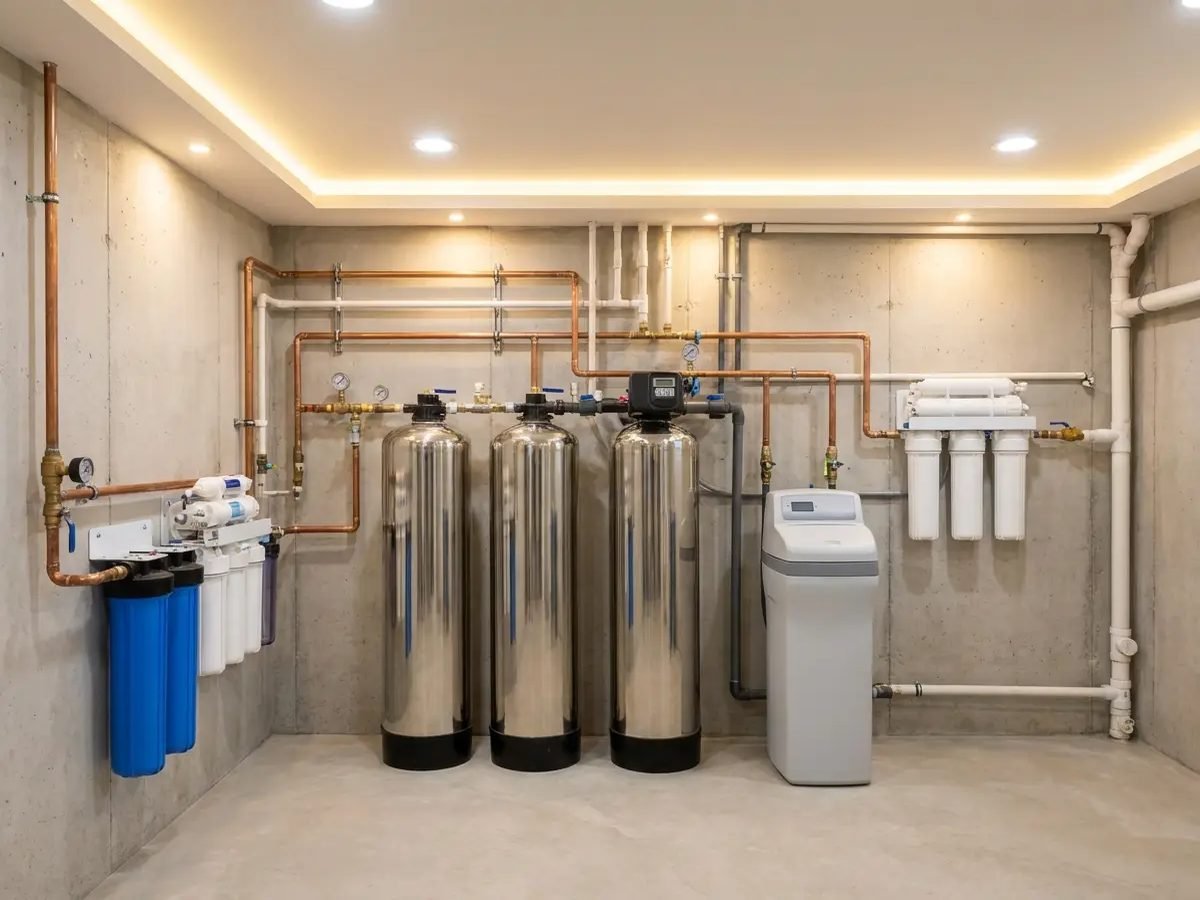
Salt-Free Conditioners vs. Traditional Softeners
Despite the name, a “salt-free water softener” doesn’t actually soften water in the traditional sense. Traditional softeners use an ion-exchange process with salt (sodium or potassium) to physically remove calcium and magnesium from the water. Salt-free systems, more accurately called conditioners or descalers, don’t remove these minerals at all—instead, they alter their structure so the minerals are less likely to stick to pipes, fixtures, and appliances as scale.
This distinction matters when comparing options, because the two technologies solve different problems and aren’t always interchangeable. Salt-free systems are sometimes marketed as “water conditioners,” “descalers,” or “scale prevention systems,” language that more accurately reflects what they actually do compared to a true softener.
How Salt-Free Conditioners Work
Most salt-free systems use one of two approaches: template-assisted crystallization (TAC), which converts dissolved hardness minerals into microscopic crystals that stay suspended in the water instead of bonding to surfaces, or electronic/magnetic descaling, which uses an induced electromagnetic field around the pipe to change how minerals behave. TAC systems are the more established and commonly installed approach; electronic descalers are less consistently effective and results can vary by home. Because performance can vary between brands and technologies, it’s worth checking for independent test data or third-party certification, such as NSF/ANSI 330, which specifically evaluates scale-reduction performance for conditioners, rather than relying on manufacturer claims alone.
Pros and Cons of Salt-Free Systems
- No salt to buy or refill. There’s no ongoing salt cost or bags to carry, and no sodium added to the water.
- No wastewater discharge. Unlike traditional softeners, which flush brine during regeneration, salt-free systems don’t produce wastewater, which can matter for homes on a septic system or in areas with water-use restrictions.
- Lower maintenance. Most TAC systems only need periodic cartridge replacement, with no moving parts to service.
- Doesn’t remove minerals. Because calcium and magnesium stay in the water, a salt-free system won’t eliminate hard water spots on glass or dishes the way a true softener can.
- Less effective at very high hardness levels. Extremely hard water may still benefit more from traditional softening.
Cost Comparison
| System Type | Typical Installed Cost |
|---|---|
| Salt-free (TAC) conditioner | $1,200 – $3,000 |
| Electronic/magnetic descaler | $300 – $1,000 |
| Traditional salt-based softener | $1,000 – $3,500 |
Estimates only — not a quote. These are national ranges compiled from public sources and industry data. They are not an offer of price and are not guaranteed. Your actual cost depends on your project, location, materials, permits and the contractor you choose. HomeMatchr does not set prices or perform work. See our full disclaimer.
Salt-free systems can cost more upfront than a comparable traditional softener, but they typically have lower ongoing costs since there’s no salt to purchase over time. Replacement cartridges or media for a TAC system typically run every three to six years, while a traditional softener needs salt purchased monthly, so the gap in upfront price often narrows or reverses over a decade of ownership.
Maintenance and What to Expect Over Time
One appeal of salt-free conditioning is how little day-to-day attention it needs. Most TAC systems have no moving parts, no tanks to monitor, and no regeneration cycle to schedule around. The main maintenance task is replacing the cartridge or media on the manufacturer’s recommended timeline. It’s worth noting that salt-free systems generally don’t reverse scale that has already built up in pipes and fixtures; they primarily prevent new scale from forming, so homes with significant existing buildup may see gradual rather than immediate improvement.
Which Option Fits Your Home
The right choice depends on your priorities and water quality. Homeowners who want to reduce scale buildup without adding sodium to their water, who are on a septic system, or who live somewhere with water softener discharge restrictions often lean toward salt-free conditioning. Homeowners who want water that actually feels “soft,” lathering differently and leaving fewer spots, or who have very high hardness levels often choose a traditional softener instead. A water test showing your hardness level in grains per gallon is the best starting point for this decision.
Some households land on a middle-ground approach: a smaller, more water-efficient salt-based softener paired with conservation habits, or a system that layers light softening with conditioning technology for a specific concern like a septic system’s brine sensitivity. A contractor who reviews your actual water test results is in the best position to walk through these tradeoffs rather than recommend a generic one-size-fits-all setup.
Questions to Ask Before You Decide
- What does my water test show for hardness, and does it fall in a range where salt-free conditioning is typically effective?
- How does this specific product’s performance compare between TAC and electronic technology?
- What’s the expected cartridge or media replacement schedule and cost?
- Will this system work with my home’s plumbing, or does it require modifications?
- How does the installed price compare to a traditional softener sized for my household?
HomeMatchr is an advertising-supported service that helps homeowners compare quotes for both salt-free and traditional water treatment systems. Request no-obligation quotes from independent contractors to see which option and price fit your home; HomeMatchr may receive a referral fee when you connect with a provider.
Frequently asked questions
Does a salt-free water softener actually work?
Salt-free systems don’t remove hardness minerals, but template-assisted crystallization technology is well documented for reducing scale buildup on pipes and fixtures by changing how those minerals behave in water.
Is salt-free water conditioning better than a traditional softener?
Neither is universally better—it depends on your goals. Salt-free systems avoid added sodium and wastewater discharge, while traditional softeners more directly address hard water effects like spotting and reduced soap lather.
How much does a salt-free water conditioner cost?
Installed costs typically range from about $1,200 to $3,000 for a template-assisted crystallization system, with basic electronic descalers costing less.
Do salt-free systems need maintenance?
Most need periodic cartridge replacement, generally every few years, but they don’t require the ongoing salt refills or brine tank cleaning that traditional softeners do.
Can I use a salt-free conditioner on a septic system?
Yes—one common reason homeowners choose salt-free conditioning is that it doesn’t produce the wastewater discharge that traditional softener regeneration cycles create, which some septic systems and local rules restrict.
Compare Water Treatment quotes
Enter your ZIP code to request no-obligation quotes from independent contractors.
HomeMatchr is an advertising-supported service and may receive a referral fee when you connect with a service provider.
